Law for a Living Planet: Why Sudhir Mishra’s Climate Justice Matters Beyond India
Book Review By Bars Across
About the authors+

Reading context+
Jurisdictions
Long before climate change became a boardroom risk, a diplomatic priority or a recurring headline, it entered India’s courtrooms in more immediate forms: polluted air, poisoned rivers, disappearing forests, hazardous waste, displaced communities and wildlife pushed towards extinction.
Each dispute appeared to concern a particular place, project or species. Taken together, however, these cases raised a far larger constitutional question: What does the right to life mean when the natural systems supporting life are themselves under threat?
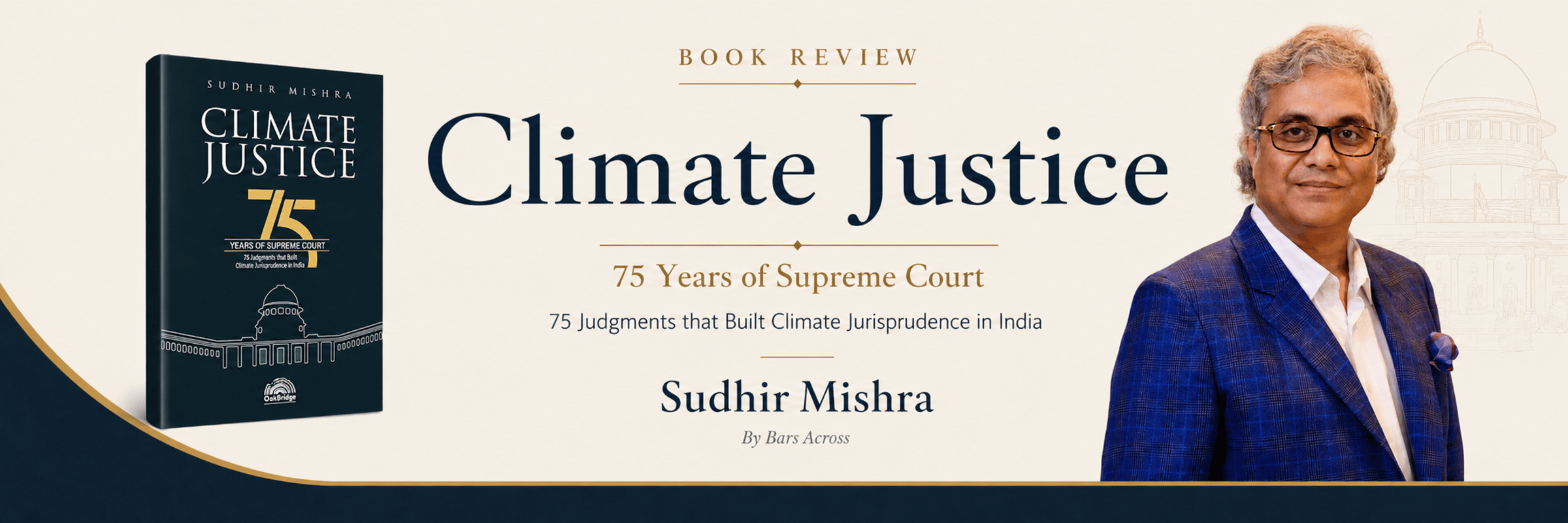
That question lies at the heart of Sudhir Mishra’s timely and ambitious book, Climate Justice: 75 Years of Supreme Court—75 Judgments that Built Climate Jurisprudence in India.
The book brings together 75 judgments delivered from the early decades of the Supreme Court through December 2025. Yet it is not presented merely as a digest of reported cases. It is an account of the legal churning through which environmental protection moved from the margins of administration to the centre of constitutional responsibility. It also records the judges and advocates whose arguments, interventions and decisions helped construct this evolving body of law.
A Constitutional Biography of Environmental India
The most compelling achievement of Climate Justice is its ability to reveal a continuous constitutional story within decisions delivered across different decades and circumstances.
India’s environmental jurisprudence was not created by a single judgment or statute. It evolved incrementally, as courts confronted industrial pollution, deforestation, urban degradation, hazardous waste, damage to rivers, threats to biodiversity and conflicts between infrastructure and ecological survival.
Mr. Sudhir traces how the interpretation of Article 21 expanded beyond protection from arbitrary deprivation of life to embrace dignity, clean air, safe water and a healthy environment. The book follows the movement of law from an older idea of dominion over nature towards an ethic of stewardship—an understanding that forests, rivers, wildlife and other ecological resources are not merely commodities available for unrestricted exploitation.
Landmark decisions associated with Maneka Gandhi, the M.C. Mehta cases and later environmental proceedings are positioned within this wider constitutional transformation. The book also considers judicial efforts concerning the Great Indian Bustard, forests and the migration corridors of tigers and elephants, demonstrating how environmental adjudication has gradually widened its moral and legal field of vision.
The result is a book about far more than environmental regulation. It is about how a Constitution responds when the consequences of development are unequally distributed, when ecological harm crosses generations and when those most affected—including wildlife, rivers and people yet to be born—cannot easily speak for themselves.
From Legal Precedent to Human Consequence
A collection of 75 judgments could easily have become dense, technical or inaccessible. Mr. Sudhir avoids that trap by treating each decision as part of a living narrative rather than as an isolated precedent.
The judgments are distilled into concise, readable accounts that retain their legal significance while explaining why they matter outside the courtroom. This approach makes the book valuable not only to judges and practising lawyers but also to policymakers, corporate leaders, ESG professionals, researchers, students, conservationists and members of the public seeking to understand how environmental rights have developed in India.
The work performs an important act of translation. Law reports record holdings, submissions and orders; citizens experience breathable or unbreathable air, protected or destroyed forests, restored or contaminated water and development that either includes or excludes them. Climate Justice attempts to bridge the distance between those two worlds.
Its brevity is both a strength and a deliberate editorial choice. Readers seeking exhaustive doctrinal commentary will still need to return to the full judgments and specialist scholarship. This book serves another purpose: it provides a navigable map of the terrain, identifies the milestones and explains the direction in which Indian environmental law has travelled.
The Sparrow as the Book’s Quiet Conscience
One of the book’s most memorable devices is the symbolic presence of a sparrow beside the judgments.
The sparrow does not appear as a decorative flourish. It functions as a gentle conscience—a reminder of what each decision sought to protect, what remains vulnerable and what must not be forgotten after the legal arguments have ended.
The choice is particularly effective because environmental law can sometimes become abstracted into doctrines, clearances, committees and compliance reports. The sparrow returns the reader to the living world behind those abstractions.
It asks a question that legislation and litigation can sometimes overlook: After the judgment has been delivered, what survives on the ground?
That question gives the book its emotional intelligence. Judgments can recognise principles, define duties and fashion remedies, but climate justice ultimately depends on implementation. Its true measure is not the eloquence of a court order but the condition of the river, forest, neighbourhood, community or species after that order leaves the courtroom.
Why This Indian Story Matters Globally
For international readers, Climate Justice is not simply a history of Indian case law. It is a case study in how a constitutional court in a vast, populous and rapidly developing democracy has attempted to reconcile economic aspiration with ecological limits.
The dilemmas examined in the book are global. How should courts respond when environmental damage threatens fundamental rights? Who represents future generations? How should scientific uncertainty be treated? What happens when public authorities fail to enforce existing protections? Can corporations be required to account for environmental consequences extending beyond immediate financial loss?
India’s experience does not offer effortless answers. What it offers is an unusually rich record of constitutional experimentation.
The book demonstrates that climate justice is not a narrow specialisation reserved for environmental lawyers. It intersects with public law, corporate responsibility, infrastructure, public health, human rights, indigenous and community interests, intergenerational equity and the rule of law itself.
For corporations and boards, it is a reminder that environmental compliance can no longer be treated as a peripheral operational issue. For governments, it illustrates how delayed enforcement can transform administrative failure into constitutional litigation. For lawyers, it shows how individual disputes can generate principles that reshape public policy for decades.
Seventy-Five Judgments and an Unfinished Story
The book does not suggest that judicial intervention alone can resolve the climate crisis. Courts can declare rights, interpret duties and hold institutions accountable. They cannot replace credible regulation, scientific capacity, responsible governance, corporate discipline or sustained public participation.
That tension makes Climate Justice especially relevant.
India’s courts have often entered environmental disputes because other institutions have acted too slowly, inconsistently or not at all. Judicial intervention has produced some of the country’s most important environmental principles, but the continued need for litigation also exposes gaps in enforcement.
The 75 judgments therefore represent both achievement and warning.
They demonstrate what constitutional law can accomplish when confronted with ecological harm. At the same time, they remind readers that every principle depends upon institutions willing to implement it.
Seventy-five judgments do not complete the story of climate justice. They reveal how that story became constitutionally possible—and why its next chapter cannot be postponed.
About Sudhir Mishra
Sudhir Mishra brings to this work the perspective of a practitioner who has spent decades at the intersection of litigation, environmental governance and institutional policy.
He is an Advocate before the Supreme Court of India and a Door Tenant at No5 Barristers’ Chambers in the United Kingdom. He was appointed Amicus Curiae in Ridhima Pandey v. Union of India, a matter concerning carbon emissions and the legal framework governing them. He was also engaged by the Central Public Works Department in proceedings connected with the proposed expansion of Supreme Court infrastructure before the Delhi High Court.
Mr. Sudhir was selected for the United States Government’s International Visitor Leadership Program in 2005. He has been honoured at the House of Lords with the first Guardians of Sustainability Award and the Environmental Lawyer of the Year Award 2022. His professional recognition includes the Forbes Legal Power List of India’s Top 100 Individual Lawyers and the India Business Law Journal’s A-List of recommended lawyers.
He has chaired ESG and climate-change initiatives associated with the Confederation of Indian Industry and the Society of Indian Law Firms. His professional work has included engagements for major Indian and international businesses, while his environmental record includes more than 400 workshops across approximately 300 protected areas and appearances in over 120 environmental matters before courts, tribunals, committees and regulatory bodies.
These experiences give the book a practical quality. Mr. Sudhir is not observing environmental jurisprudence solely from an academic distance. He writes as someone familiar with the difficult territory between legal principle, commercial reality, institutional capacity and ecological urgency.
What Leading Voices Have Said
“A must read for climate practitioners, policy makers to secure climate justice in decades forward.”
Dr. Lalit Bhasin - (President, Society of Indian Law Firms; Former President, Bar Association of India)
“A distinguished environmental lawyer presents a compelling account of India’s climate jurisprudence, highlighting its global leadership in shaping climate justice.”
Prof. (Dr.) C. Raj Kumar - (Founding Vice-Chancellor, O.P. Jindal Global University and Dean, Jindal Global Law School)
“Climate justice demands action now, because a liveable future is not a privilege, it is a right.”
I. Bobby Majumder - (Partner and Head of India Desk, Frost Brown Todd LLP, Dallas, United States)
“Sudhir Mishra distills India’s evolving climate jurisprudence with clarity and authority.”
Mohammad Khalid Sayeed Pasha - (IUCN Asia Regional Head, Protected, Conserved and Heritage Areas)
“India’s climate jurisprudence, an essential reference and powerful guide for shaping the future of climate justice.”
Prof. Sabu Padmadas - (University of Southampton, United Kingdom)
“From the Campus Law Centre to serving as Amicus Curiae before the Supreme Court, this work captures the soul of Indian environmental law.”
Dr. Rajesh Satya Sehgal - (Chief Legal Officer—Energy Business, Adani Power)
“The book transforms legal precedents into stories of responsibility, reminding us that environmental protection is inseparable from justice itself.”
Prerna Pandey - (Advocate, Supreme Court of India)
“A must read book on climate law jurisprudence.”
Ravindra Kumar- (Partner – International Arbitration and Dispute Resolution, India Desk, Gunnercooke LLP, UK)
“Simple, lucid, engaging law book which will be a reference book for all law students in India.”
Dr. Richa Chaudhary - (Dean, SGT University)
“Much needed book on the role of Supreme Court of India in saving ecology & environment.”
Sanjeevi Shanthakumar - (Director & Vice Chancellor, Gujarat National Law University)
The Verdict
Climate Justice succeeds because it recognises that environmental jurisprudence is ultimately about relationships: between citizens and the state, development and restraint, present needs and future survival, human ambition and the limits of the natural world.
Lawyers will find in it a structured map of key precedents. Students will find an accessible entrance into a complex field. Policymakers will encounter a record of institutional responsibility. Corporate leaders will see why climate and environmental risk now belong within serious governance and legal strategy. General readers will discover that many protections they take for granted were built through years of argument, advocacy and judicial courage.
Most importantly, the book makes environmental law feel alive.
It reminds us that the Constitution is tested not only by how it protects those who can enter a courtroom, but also by whether it can hear the river, the forest, the endangered species, the vulnerable community and the generation that has not yet been born.
That is the enduring message of Sudhir Mishra’s work: the Earth may not file a petition, but justice must still learn to hear it.
Book Details
Title: Climate Justice: 75 Years of Supreme Court—75 Judgments that Built Climate Jurisprudence in India
Author: Sudhir Mishra
Publisher: OakBridge Publishing
Format: Paperback
Pages: 231
Edition: First Edition, 2026
ISBN: 978-81-996245-5-9 (OakBridge)
Buy the Book
Climate Justice is available for purchase on Amazon India:
https://www.amazon.in/Climate-Justice-Judgments-Jurisprudence-Oakbridge/dp/B0GTZJV8DH