Bhiwandi Legal Fraternity Discusses Land, Compensation, and RoW in Power Transmission Projects
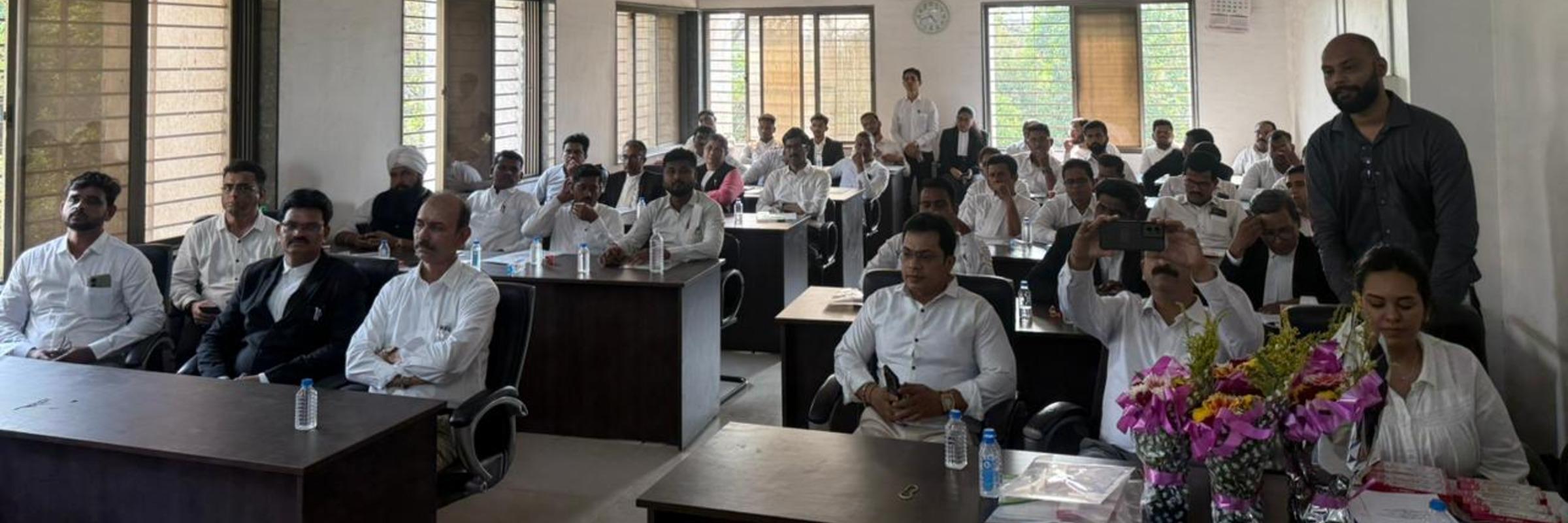
A legal awareness programme was conducted at the Bhiwandi Court under the aegis of the Bhiwandi Taluka Bar Association, bringing together over 75 legal professionals and eminent legal and policy experts to deliberate on key legal and practical issues related to power transmission projects.
About the authors+

Reading context+
Jurisdictions
Topics
Bhiwandi, May6: A legal awareness programme was conducted at the Bhiwandi Court under the aegis of the Bhiwandi Taluka Bar Association, bringing together over 75 legal professionals and eminent legal and policy experts to deliberate on key legal and practical issues related to power transmission projects.
The session, led by Adv. Ravi Bhoir, President of the Association, and Adv. Pramod Hajare, focused on strengthening understanding of the legal framework governing transmission infrastructure, particularly the Electricity Act, 2003, and the Indian Telegraph Act, 1885.
Experts highlighted that Right of Way (RoW) remains one of the most critical challenges in transmission projects, often leading to disputes due to limited awareness. It was clarified that RoW does not involve land acquisition but grants only a “right of user,” with compensation payable for damages such as crop loss and tower installation.
Key provisions under Sections 67, 68, and 164 of the Electricity Act were discussed, including the powers of transmission licensees to lay lines, requirements for government approvals, and the applicability of Telegraph Act provisions for infrastructure deployment.
The panel also referenced important judicial precedents, including Power Grid Corporation of India Ltd. vs. Century Textiles & Industries Ltd., which upheld that prior consent of landowners is not required once statutory approvals are in place, reinforcing the importance of transmission infrastructure in the larger public interest.
The session featured expert speakers including Adv. Devesh Juvekar, Adv. Honey Chandanani, Adv. Yogesh Yogi, and Shri Sanjay Jog, who provided practical insights on compensation frameworks, dispute resolution mechanisms, and legal remedies available to affected stakeholders.
The programme concluded with an interactive discussion, emphasising the need for greater legal clarity to reduce disputes and facilitate smoother implementation of critical power infrastructure projects.
Key Questions Raised by Legal Participants
1. What are the common legal disputes between landowners and transmission companies, and how are they resolved?
Common legal disputes between landowners and transmission companies arise around the alignment of transmission lines, acceptance of compensation, and resistance or obstruction during execution of the project. These matters are governed by the Electricity Act, 2003, and the Indian Telegraph Act, 1885, especially where powers under Section 164 are applied.
Once a company obtains approval from the State Government, it enjoys the powers of an authority and does not require approval from local bodies such as the Gram Sabha or Gram Panchayat. Courts (including the Supreme Court) have repeatedly held that public interest in electricity transmission overrides private property rights under this framework.
Disputes regarding compensation or rights are first addressed before the Sub-Divisional Magistrate (SDM) and then the District Collector. If disagreements persist, the affected party may approach the District Judge. While aggrieved parties may also approach High Courts, experience suggests that High Courts are generally reluctant to grant stay orders and have consistently held that the rights of landowners are limited to fair compensation. Landowners cannot seek judicial intervention to stop the work or alter the alignment of the power line.
2. Can a landowner influence the location of a transmission tower? Can changes be requested, and what factors affect the final decision?
Tower placement is primarily determined based on technical feasibility, safety clearances, terrain conditions, and cost efficiency, including maintaining the shortest viable route. As per legal provisions and judicial precedents, route alignment is decided through techno-economic evaluation, and prior consent of landowners is not mandatory when statutory powers are exercised.
3. How is compensation assessed and paid in transmission projects? Who decides the amount, and what does it cover?
Compensation is determined by district administration authorities such as the Sub-Divisional Officer (SDO), Collector, or other designated officers, based on applicable government guidelines. The transmission company is responsible for disbursing the compensation as determined by the competent authorities and does not have the authority to modify or enhance the assessed amount independently.
Compensation typically covers damage to crops, trees, land, and other structures, as well as impacts due to Right of Way (RoW) restrictions, such as limitations on construction or land use beneath the transmission line. The law also mandates that companies must minimise damage and provide fair compensation for any loss incurred.
4. What is the legal status of land under transmission lines? How does RoW work, and does it impact ownership or 7/12 records?
Under transmission laws, there is no acquisition of land; instead, only a Right of Way (RoW) is exercised, allowing the transmission company limited rights to use the land for installing and maintaining transmission lines.
Right of Way (RoW) refers to the corridor or area under and around the transmission line where certain restrictions apply, such as limitations on construction or land use. However, ownership of the land remains with the landowner, and land records such as the 7/12 extract are not affected or altered.
The transmission company’s rights are restricted only to the extent necessary for the transmission line and cannot be extended for any other purpose.